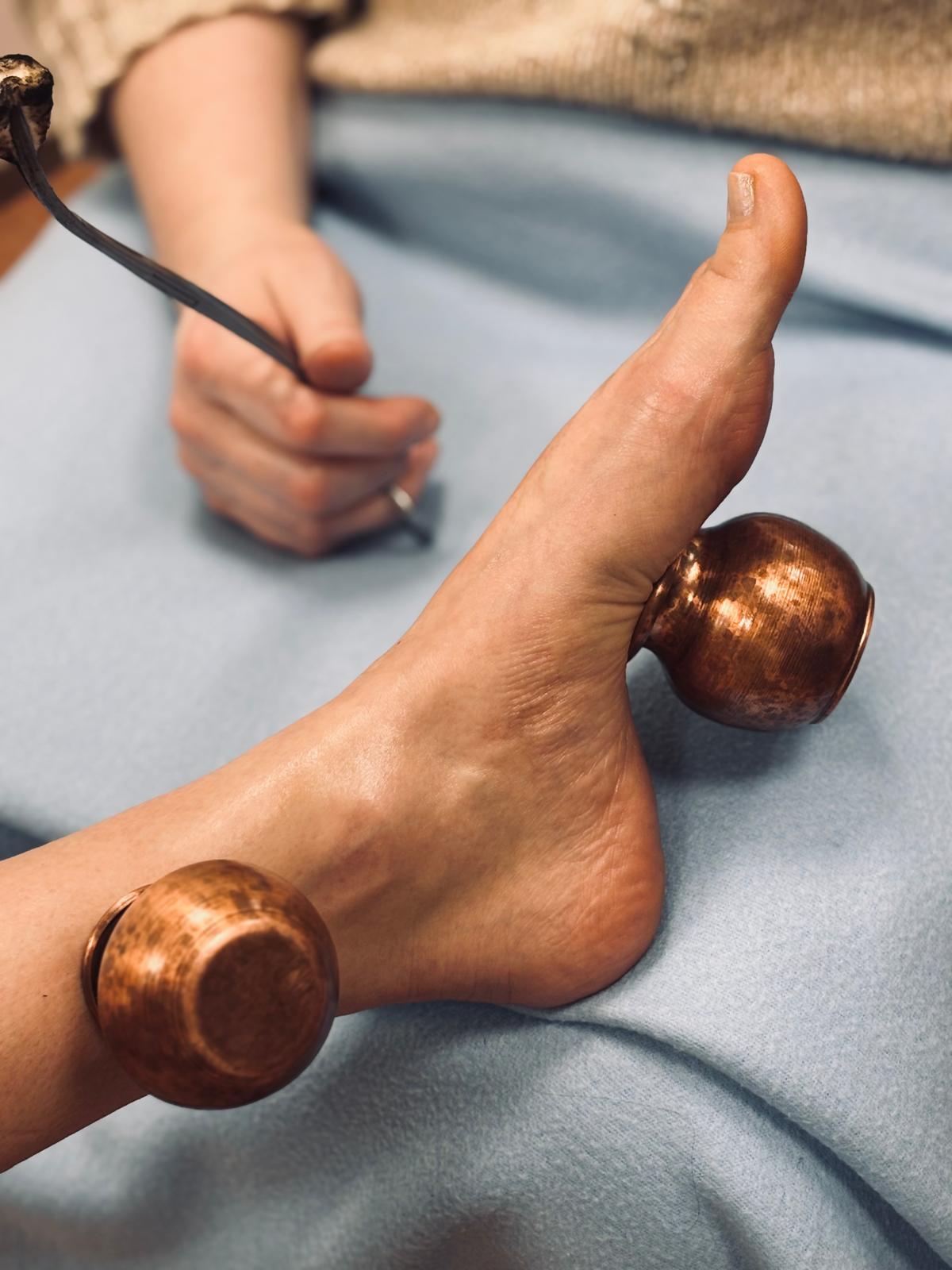
TCM Cupping: What Those Marks Actually Mean
If you have ever had cupping, you know the marks. Round, dark, dramatic — and often alarming if nobody explained what they actually are.
They are not bruises. They are something far more interesting: a clinical diagnostic signal that tells a trained TCM practitioner exactly what is happening in your tissues before a word is spoken.
This is how to read them.
What cupping actually does
Cupping therapy (bá guàn liáo fǎ 拔罐療法) has been documented for over 3,000 years — in ancient Egyptian papyri, in Hippocrates' writings, and independently across traditional Chinese, Arabic, and Southeast Asian medicine. The Chinese tradition evolved from buffalo horn cups in the 3rd century CE through bamboo and ceramic to the glass fire cups and vacuum cups used today.
The mechanism is simple in principle: a cup is placed on the skin and the air inside is evacuated, creating negative pressure. This suction decompresses the tissue, separating the skin and fascia from the muscle layers beneath. Blood and lymph are drawn upward into the space created. When blood vessels in that area are compromised — stuck, restricted, or loaded with stagnant metabolic waste — they rupture microscopically, producing the mark.
This is what distinguishes a cupping mark from a bruise:
- A bruise is caused by external trauma — a blow that crushes tissue from outside in.
- A cupping mark (sha) is caused by internal pressure drawing compromised blood upward from restricted tissue.
The mark appears where the restriction was. It is the restriction, made visible.
The colour guide: reading the diagnostic signal
The colour, density, and texture of the mark after cupping is a direct reflection of the tissue state underneath. In classical TCM terms, this is called reading the sha. In modern terms, it reflects the concentration of deoxygenated blood, metabolic byproducts, and inflammatory mediators in the fascial and muscular layers.
No mark or very pale pink The tissue is either healthy — good circulation, minimal restriction — or significantly depleted (xu): anaemia, deep exhaustion, or chronic deficiency. When a client has pain but leaves no mark, the TCM interpretation is energy deficiency rather than stagnation. Moxibustion (warming therapy) rather than more cupping is typically indicated.
Light pink to bright red Mild, recent stagnation. Good vascular response. Marks of this colour typically fade within a few hours to one day. This is the most common presentation in people who receive bodywork regularly and have reasonably healthy circulation.
Bright red without darkness In TCM, this indicates yin deficiency — lack of cooling fluids in the tissue, which corresponds physiologically to local dehydration, overactivated sympathetic tone, or chronic inflammation in early stages. Fades in 2–3 days.
Dark red Moderate blood stagnation with heat. Chronically overworked tissue — the upper back in someone who has spent years at a desk, the posterior chain in an athlete who under-recovers. Fades in 3–7 days. This is the most common presentation in active adults.
Purple or violet Strong stagnation, circulatory blockage. Chronically oxygen-deprived tissue, high concentration of acidic metabolic waste in the interstitial space. Often appears in areas of old injury or habitual holding patterns. Fades in 5–10 days.
Dark purple to black Extreme, longstanding stagnation. Often appears in first-time clients who carry years of accumulated restriction — especially in the thoracic spine, trapezius, and posterior hip. The tissue has been underperfused for a long time. The mark reflects how much was there to release, not how hard the therapist worked. Fades in 1–2 weeks, occasionally up to 3 weeks.
Blue-purple (Cold-Damp pattern) In TCM this indicates a Cold-Damp pathogen lodged in the tissue — physiologically, vasospasm from habitual cold exposure combined with localised fluid retention. Common in people who spend time in cold environments or who have chronic rheumatic conditions. Requires warming moxa after cupping. Fades in 5–10 days.
Brown or yellow Not a colour that appears immediately — this is the transition phase as the mark resolves. Haemoglobin breaks down via macrophage activity into biliverdin (green) and bilirubin (yellow-brown). Its appearance is a sign the body is actively metabolising and clearing what was released.
Blistered (fluid-filled) A sign of significant Dampness in TCM — physiologically, seepage of serous fluid when suction is applied to tissue that already has significant interstitial congestion, or over areas of active respiratory infection. Requires sterile management and resolves in a few days.
What this means for your session
A practitioner who reads the sha properly can build a session-by-session picture of your tissue state without expensive imaging or blood tests.
First session: often the darkest marks of your treatment history, especially in the thoracic spine and shoulder region. This is not damage — it is the accumulated restriction of years, released at once.
Subsequent sessions: marks typically lighten progressively. A region that produced dark purple in session one may produce bright pink in session four. This progressive lightening is the clinical evidence that the therapy is working.
No further change in colour: means the restriction has cleared in that region. Work can shift elsewhere.
Types of cupping used at Body Kind
Not every client receives the same technique. The selection depends on your constitution, the condition being addressed, and how your body responds.
Fire cupping — a cotton pad soaked in alcohol is briefly ignited inside the glass cup to burn off the oxygen, creating suction as the cup is placed on the skin. The synergy of negative pressure and Yang thermal energy makes this particularly effective for deep Cold-Damp patterns, chronic fascial restriction, and respiratory conditions. This is the classical method, and the one most clients associate with TCM.
Vacuum cupping — a plastic or silicone cup with a hand pump. Allows precise control of suction strength, making it suitable for more sensitive clients or areas where fine adjustment matters. No fire, no thermal element.
Moving cupping (sliding) — a cup is applied to oiled skin and moved along the fascial lines rather than held in a fixed position. This produces a myofascial release effect similar to instrument-assisted soft tissue mobilisation, breaking up adhesions and encouraging lymphatic drainage without leaving fixed marks. Common in the Premium TCM Therapy session.
Flash cupping — rapid repeated application and removal of the cup without leaving it in place. Intense local circulation stimulation without marks. Used in areas where marked suction is contraindicated or for clients with significant deficiency.
The immune mechanism — why local cupping produces systemic effects
The most clinically significant effect of cupping is not mechanical but immunological. When capillaries rupture under suction, haemoglobin fragments are released into the tissue. These are processed by resident macrophages, which triggers upregulation of haem oxygenase-1 (HO-1) — an enzyme with powerful anti-inflammatory and cytoprotective properties.
HO-1 catalyses the breakdown of haem into three products: biliverdin (antioxidant), free iron (sequestered rapidly by ferritin), and carbon monoxide (CO). The CO acts as a gaseous signalling molecule — activating soluble guanylate cyclase, producing vasodilation and long-term reduction in vascular smooth muscle tone. It also switches macrophage phenotype from pro-inflammatory (M1) to anti-inflammatory and regenerative (M2).
This explains why a cupping session on the upper back produces effects well beyond the treated area — systemic anti-inflammatory response, improvement in organ function, and immunomodulation — through a clearly mapped biochemical cascade.
Contraindications — when cupping is not appropriate
Cupping at Body Kind is always preceded by an intake interview. There are clear clinical contraindications:
Absolute contraindications:
- Blood clotting disorders or anticoagulant medication (warfarin, heparin, etc.) — risk of uncontrolled subcutaneous bleeding
- Active malignancy
- Open wounds, burns, or active skin infections in the treatment area
- Pregnancy — cupping is contraindicated on the abdomen and lumbar-sacral region throughout pregnancy
- Severe physical exhaustion, high fever with convulsions, or acute cardiorespiratory failure
Relative contraindications (requiring modified technique or assessment):
- Varicose veins — avoid direct application
- Severe anaemia or significant qi/blood deficiency — flash cupping only, followed by moxa
- Very thin or fragile skin
- Active severe inflammatory flare (acute gout attack, severe acute dermatitis)
If you are on any medications or have a relevant medical history, disclose this at booking — it allows appropriate session planning rather than discovering a contraindication when you arrive.
Frequently asked questions
How long do the marks last? Light pink: hours to 1 day. Bright red or dark red: 3–7 days. Purple or black (first session or deep restriction): 1–2 weeks. The darker the mark, the more stagnation was present — and the faster it typically clears after subsequent sessions.
Can I have cupping if I'm taking aspirin or ibuprofen? Low-dose aspirin (75–100 mg as cardiac prophylaxis) is generally compatible with dry cupping. Higher doses or prescription anticoagulants — warfarin, rivaroxaban, apixaban, etc. — are a contraindication. Always disclose at booking.
Will it hurt? Fire and vacuum cupping produce a strong pulling sensation — not sharp pain, but significant pressure. Moving cupping across the back feels like deep tissue work. The sensation during treatment is typically experienced as intense but not distressing; most clients find it deeply satisfying in the way any release of long-held restriction is satisfying.
Can I exercise after cupping? Light walking is fine. Intense exercise, swimming, or exposure to cold within 24 hours of cupping is discouraged — the tissue has been actively opened and needs time to consolidate the work.
Is fire cupping safe? In trained hands, yes. The technique requires precision — the burning pad is in the cup for seconds only, the flame never touches the skin. Julia Piekarska is trained in both fire and vacuum cupping at TOMO School and applies fire cupping exclusively in appropriate clinical contexts.
Body Kind Studio offers cupping as part of the Chinese Cupping & Gua Sha (60 min, 250 PLN) and Premium TCM Therapy (120 min, 420 PLN) sessions — Mikołajska 11/13, Kraków Old Town, 3 minutes from the Main Square.
Local or have the app?
Book instantly via BooksyTourist or need help?
Message on WhatsApp