Why Authentic Thai Massage Works: Sip Sen, Fascia, and 2,500 Years of Clinical Practice
Authentic Thai massage is not stretching with nice music. It is a 2,500-year-old therapeutic system rooted in Buddhist medicine, Ayurveda, and the ten energy lines of the human body — and modern anatomy confirms, again and again, why it works.
This is what separates it from the 60-minute hotel version offered on a table with oil. The structure is different. The intention is different. The results are different.
Where Thai massage comes from
The system is called Nuad Thai or Nuad Boran (ancient touch) in Thai. Its founding figure — revered in Thailand as the Father of Medicine — is Jivaka Kumara Bhacci, the personal physician of the Buddha and King Bimbisara of Magadha, who lived in the 5th century BCE. He integrated early Buddhist ethics of compassion with advanced herbalism and manual techniques that later spread through Southeast Asia via Buddhist monks.
By the Ayutthaya Kingdom (1350–1767), manual medicine was institutionalised. In 1455, King Trailokanat established the Krom Mor Nuad — the Royal Department of Massage — as one of six official medical departments. This was not alternative therapy. This was state medicine.
When the Burmese destroyed Ayutthaya in 1767, most medical manuscripts were lost. King Rama I began reconstruction by transferring the capital to Bangkok and having surviving formulas carved into the walls of Wat Pho temple. In 1832, King Rama III completed this work with 60 stone tablets showing energy line diagrams and 80 bronze statues demonstrating therapeutic yoga postures.
In December 2019, Nuad Thai was inscribed on the UNESCO Representative List of Intangible Cultural Heritage of Humanity — formal international recognition of this tradition as a living world heritage practice.
The Sip Sen: ten energy lines that map onto your fascia
The theoretical foundation of Thai massage is the Sip Sen — ten principal energy channels (also called Sen Sib or Sen Prathan Sib). According to Thai medicine, the body contains 72,000 invisible channels through which lom (the life wind, equivalent to Indian prana and Chinese qi) flows. Ten of these are primary. All originate in the abdomen near the navel and radiate outward to the extremities and sensory openings.
Blockages in these channels — caused by accumulated stress, chronic posture, emotional suppression, or physical trauma — disturb the balance of the Four Elements that constitute the body:
| Element | Corresponds to | Signs of imbalance |
|---|---|---|
| Earth (Din) | Bones, joints, muscles, tendons, skin | Joint stiffness, muscle pain, fascial tension |
| Water (Nam) | Blood, lymph, bile, synovial fluid | Oedema, poor circulation, dry joints |
| Wind (Lom) | Breath, nerve impulses, energy movement | Fatigue, insomnia, headaches, energy blockages |
| Fire (Fai) | Body heat, metabolism, digestion | Inflammation, fever, metabolic sluggishness |
The ten Sen lines each have a precise anatomical path and a specific therapeutic reach. A few of the most clinically relevant:
Sen Sumana runs centrally from above the navel upward through the sternum, throat, and tongue. It governs the heart and lungs, and its release addresses asthma, depression, and anxiety. In Western anatomy, this maps closely onto the anterior fascial line of the trunk.
Sen Ittha and Sen Pingkhala are left and right channels running from the navel down to the groin, up the posterior chain, and terminating in the left and right nostril respectively. They correspond to the lunar (cooling, nervous system) and solar (activating, metabolic) energy poles of the body — and anatomically trace the deep posterior fascial line and the paths of the major nerve trunks along the spine.
Sen Kalathari branches from above the navel through all four limbs, ending in the fingers and toes. It coordinates the entire musculoskeletal system, and work on it addresses rheumatic pain, psychophysical tension, and mental-emotional disturbance — all through the same mechanical release of fascial adhesion along the limb lines.
Sen Nanthakrawat branches below the navel to the urinary tract and rectum. Work here addresses constipation, bloating, gynaecological conditions, and lower back pain — the entire pelvic basin, in Western terms.
The practitioner's job is to read where the flow is blocked along each line, and to systematically restore it through compression, traction, and assisted stretch — not to follow a predetermined routine.
What actually happens in the tissues
Modern anatomical research has confirmed what Thai practitioners have mapped empirically for millennia: the body's tension patterns are organised along continuous fascial chains that connect from foot to skull. Releasing restriction at one point on the chain produces downstream effects far from the point of intervention — which is why work on the feet affects the lower back, and work on the posterior neck affects the breath.
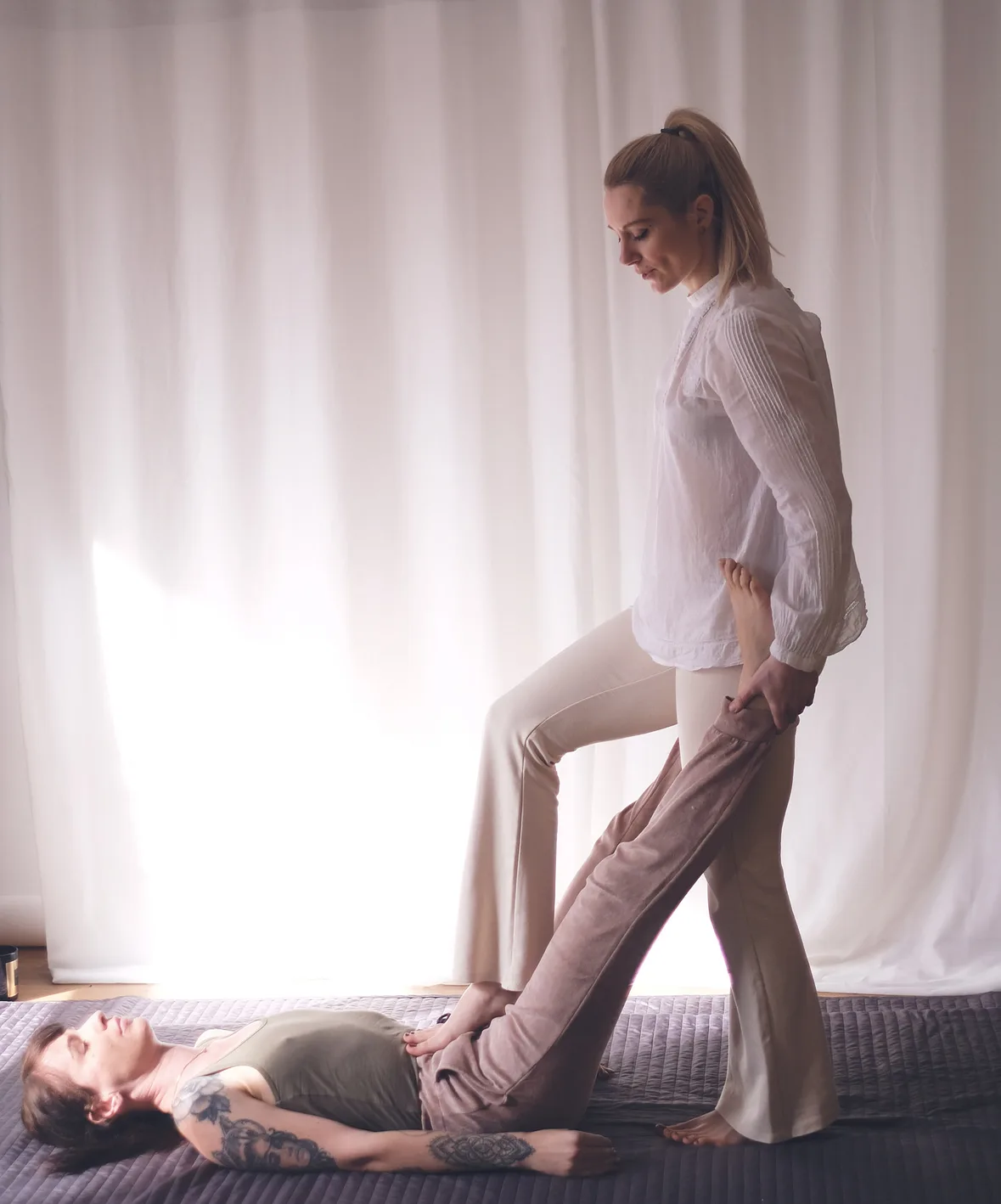
During a Thai session, the therapist uses thumbs, palms, forearms, elbows, knees, and feet to apply graduated, sustained pressure along the Sen lines. The patient is also passively moved through assisted yoga postures — hip openers, spinal traction, shoulder mobilisation — that load and release the major fascial chains in ways ordinary stretching cannot.
The key mechanism is sustained mechanical load on fascial tissue. Fascia responds to slow, held pressure (not quick stretching) with a process called thixotropy — the tissue softens and becomes more pliable under sustained compression, allowing adhesions to release and hydration to restore. This is why the results of authentic Thai massage persist for days or weeks, while a brief stretch at the gym reverts within minutes.
The second mechanism is breath-synchronised parasympathetic activation. Slow pressure applied with each exhale signals the nervous system to downregulate from sympathetic (fight-or-flight) to parasympathetic (rest and repair) activation. Muscle spindle receptors stop firing their contraction signal. The muscle releases — not because it was forced, but because the nervous system stopped holding it.
The classical 150-step sequence
The full classical session, as taught at Wat Pho Thai Traditional Massage School (founded 1955, the first school approved by the Thai Ministry of Education), follows a sequence of exactly 150 therapeutic steps across five body positions:
- Supine — acupressure on the soles and leg lines
- Side-lying — deep passive stretch of the iliotibial band and gluteal complex
- Prone — Sen line compression along the back, thoracic spinal decompression
- Supine again — chest, shoulders, neck, face, and skull
- Seated — assisted spinal rotations and shoulder girdle stretch
Before beginning, a practitioner trained in the traditional way performs the Wai Khru ceremony — a moment of breath, intention, and formal gratitude to the lineage of teachers stretching back to Jivaka himself. This is not ritual for ritual's sake. It is what distinguishes a clinical practitioner from someone following a script.
What separates authentic Thai from a hotel spa version
This distinction matters practically.
A table massage in a spa — even marketed as Thai — uses oil, restricts the therapist to surface gliding techniques, and follows a fixed routine that cannot adapt to the structural patterns of your specific body. The therapeutic logic is completely different.
Authentic Thai massage uses:
- A mat on the floor — the therapist uses body weight, not arm strength, producing more consistent and appropriate pressure
- No oil — loose clothing allows the full range of compression, traction, and assisted stretch
- A trained practitioner reading your body in real time — adjusting every technique to what they find, not what the script says
- The full 150-step sequence across all five positions — the complete systematic intervention on all the primary Sen lines
The difference in outcome between a scripted 60-minute table version and an authentic 90–180 minute session is not a matter of degree. It is a different intervention entirely.
How to choose your session length
90 minutes — a focused, systematic reset across the primary Sen lines. Appropriate for first-time clients and regular maintenance. You will feel the whole body addressed, though some areas will receive less time.
120 minutes — the standard clinical recommendation. Allows full-body work with adequate time in the areas that need it most, plus unhurried work on the neck, skull, and face.
180 minutes — The Jivaka Ritual — the complete, traditional form of the work. Three hours without time pressure allows the session to go through not just the physical tension, but the deeper psychosomatic layers held in the jaw, the breath, and the pelvis. Named after the founder of the lineage. Full details in our dedicated article: The Jivaka Ritual.
Folk style vs royal style — why it matters
Thai massage evolved into two distinct technical traditions. Nuad Rajasamnak (royal style) was developed for monarchs in the palace — the therapist moved only on knees, kept a full arm's distance, and used only thumbs and palms. Feet were rarely touched; the head was never massaged.
Nuad Chaleysak (folk style) — the tradition most visitors encounter — evolved in rural communities based on trust and closeness. The therapist uses hands, forearms, elbows, knees, and feet. The session begins at the soles and works upward through assisted yoga stretches. This is the style Body Kind practises: the full instrumentarium, the complete body, no artificial restrictions.
The hotel version you may have tried elsewhere is often neither — it is a table massage with oil marketed as Thai. The therapeutic logic is entirely different.
After your session
Mild muscle soreness the next day is normal and generally welcomed — it means tissue is reorganising. Drink extra water. Move gently. Give your body a quiet evening.
Most clients report that they are standing differently within 24 hours. The forward-rounded shoulders have dropped back. A lower back locked for months has released. This is structural change, not temporary relaxation. The work of 2,500 years of clinical practice, applied to your specific body, now.
Local or have the app?
Book instantly via BooksyTourist or need help?
Message on WhatsApp